
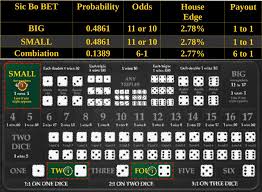
Sic Bo is an ancient Chinese casino game played with three dice. It translates literally to “precious dice.” While the crowded table layout might seem intimidating at first glance, the game is actually straightforward once you break down how the betting options, payouts, and mathematical odds connect.
What Is a Sic Bo Payouts and Odds Chart?
A Sic Bo payouts and odds chart maps out every single bet you can place on a standard table. Because there are three dice in play, there are exactly 216 possible visual outcomes (). The chart tells you how likely each outcome is to hit, and exactly how much the house will pay you when it does.
How Sic Bo Odds Work
The odds in Sic Bo represent your mathematical probability of winning. Since everything relies on three six-sided dice, calculating the total possibilities is clean science.
- A Small bet wins on 108 out of those 216 combinations (excluding triples), giving you exactly a 48.61% chance of winning.
- A Specific Triple (like rolling exactly three 4s) only has 1 winning combination out of 216, leaving you with a slim 0.46% chance.
How Sic Bo Payouts Work
Payouts are inversely related to risk: the less likely an outcome is to happen, the higher the house pays you out. Payouts are written as ratios like 1:1 (Even Money) or 180:1.
Note on regional variance: Sic Bo payouts are not legally standardized worldwide like Roulette. Macau casinos, Atlantic City properties, Las Vegas strip resorts, and online live dealer platforms each have minor variations in their payout structures to adjust their structural house edge.
Sic Bo Payouts and Odds Chart
The matrix below outlines the typical payout structures and mathematically precise probabilities found across standard land-based and online casino setups.
Specific Bet Breakdowns
Big and Small Bets
These are the foundational components of any conservative Sic Bo strategy.
- Small: Wins on totals 4 through 10.
- Big: Wins on totals 11 through 17.
The Catch: If any triple appears (e.g., 2-2-2 or 5-5-5), both Big and Small bets automatically lose. This rule gives the casino its 2.78% structural house edge on even-money spots.
Total Bets
You wager on the precise sum of all three dice, ranging from 4 to 17. Extreme totals are far less likely than middle-of-the-road totals:
- Totals of 4 or 17: Hardest to hit (only 3 unique combinations each). Payouts usually sit at 60:1.
- Totals of 9, 10, 11, or 12: Most common sums. Payouts drop to 6:1 because the mathematical probability of hitting them is significantly higher.
Single Number Bets
Placed on the bottom row of a standard table (numbers 1 through 6). The payout depends heavily on how many dice face up with your chosen number:
- 1 Die matching = 1:1 payout
- 2 Dice matching = 2:1 payout
- 3 Dice matching = 3:1 payout
Double Bets
A bet that a specific pair of numbers will appear among the three rolled dice (for example, at least two 3s). It carries a 10:1 or 11:1 payout depending on casino rules, with roughly a 7.41% likelihood of hitting.
Triple Bets
The ultimate long-shot wager on the board.
- Specific Triple: Betting on an exact set of three numbers (e.g., 6-6-6). Yields up to 180:1, but only offers a 0.46% probability.
- Any Triple: Covers all six possible triple sets at once. It pays out 30:1 or 31:1.
Combination Bets
A bet that two distinct numbers will show up across the three dice (like a 2 and a 5). This has a 6:1 payout with a 13.90% probability of success.
Best Sic Bo Bets Based on Odds
If your goal is to preserve your bankroll and systematically grind down a bonus structure or playing session, stick exclusively to Big and Small bets. Boasting a low 2.78% house edge, these options run identical math to the pass/don’t pass lines in Craps or the main player/banker positions in Baccarat.
Highest Paying Sic Bo Bets
The highest paying wager on the table is the Specific Triple, paying out 180:1 in liberal jurisdictions and 150:1 in tighter venues. While a $10 bet turning into $1,800 is an attractive concept, remember that the math is working against you: the true odds are 215 to 1, creating a steep house edge exceeding 16%.
Understanding Risk vs Reward in Sic Bo
Sic Bo is purely a game of independent random trials. Successful players balance their layouts using a combination of inside and outside wagers.
[Low Risk / Low Reward]   ------------------->   [High Risk / High Reward]
Big/Small Bets (1:1)       Dice Combos (6:1)     Specific Triples (180:1)
A balanced approach often involves placing a stable anchor bet on Big or Small while sprinkling small, speculative chips on a dynamic Total or Single row option.
Common Mistakes When Reading Sic Bo Odds
- Assuming Triples Are Covered by Big/Small: Many newcomers assume a total of 6 satisfies a “Small” bet, failing to realize that rolling a triple-2 (2-2-2) cancels out the small win entirely.
- The “Gambler’s Fallacy” Trap: Believing that because “Big” has landed five times consecutively, “Small” is overdue. The dice mechanical shaker retains zero memory; every single shake features a fresh 48.61% chance for either side.
- Ignoring Table Variance: Placing bets without looking at the printed payouts on the felt. Playing on a 150:1 triple board when a 180:1 option is available nearby gives away edge unnecessarily.
Understanding the Sic Bo layout comes down to recognizing that every block on the table is just a different combination of the same 216 dice outcomes. By leaning heavily on the high-probability Big and Small areas and steering clear of heavy investments in low-probability triples, you can enjoy this classic dice game while keeping the mathematical house advantage to an absolute minimum.