
Getting confused by the scoreboard at a baccarat table? You are definitely not alone. The most common mistake new players make is assuming baccarat scores exactly like blackjack. In reality, baccarat has its own unique, straightforward mathematical framework.
Whether you are mid-session at a live dealer table or practicing in demo mode, here is a clear breakdown of the baccarat card values so you can track your hands accurately without the guesswork.
The Official Baccarat Card Values List
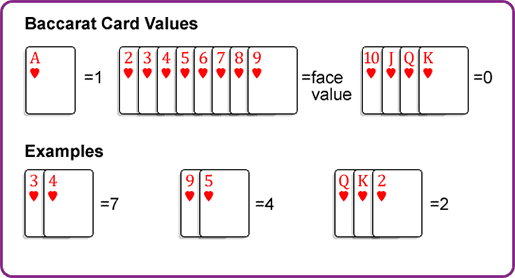
Unlike other card games where face cards hold the highest value, baccarat shifts things around. The scoring system is strictly divided into three simple categories:
| Card Type | Individual Value | Table Role |
|---|---|---|
| Aces | 1 Point | Always valued at one, never eleven. |
| 2 through 9 | Face Value | Worth exactly the number printed on the card. |
| 10s, Jacks, Queens, Kings | 0 Points | Completely worthless in hand calculations. |
The Zero Rule: In baccarat, tens and all picture cards (Jacks, Queens, Kings) are collectively referred to as “Monkeys” or zeros. They add nothing to your total hand value.
How to Calculate a Baccarat Hand
Calculating your final score in baccarat requires understanding one fundamental law: a hand total can never exceed 9.If the combined sum of the cards dealt to either the Player or the Banker results in a double-digit number, you simply drop the first digit (the tens column). The remaining single digit becomes the official score.
Hand Calculation Examples:
- Example A (Simple): You are dealt a 3 and a 5. Your total score is a pure 8.
- Example B (Dropping the Ten): You are dealt an 8 and a 7. Mathematically, 8+7=15. You drop the first digit (1), leaving you with a final hand score of 5.
- Example C (The Monkey Effect): You are dealt a King and a 9. Because the King is worth 0, your total score is a 9 (known as a “Natural”).
Key Terms Beginners Need to Know
- Natural: When the initial two-card hand dealt to either the Player or Banker totals an 8 or a 9. When this occurs, the round ends instantly, and payouts are distributed.
- The Third-Card Rule: If neither side hits a natural, a highly specific set of automated dealer rules dictates whether a third card must be drawn. You do not need to memorize this to play, as the software handles it automatically.