
Baccarat is famously known as a high-stakes, elegant casino game with incredibly simple betting choices. However, beneath its straightforward exterior lies a automated mechanism that often confuses beginners: the Baccarat Third Card Rule. This comprehensive guide breaks down exactly when the Player or Banker must draw a third card, how it affects your odds, and why mastering this mechanical rule will elevate your betting confidence.
What Is the Third Card Rule in Baccarat?
Why the Third Card Rule Is Important
The third card rule dictates whether either hand receives an extra card after the initial two-card deal. Because it is completely fixed and mandatory, neither the player nor the dealer can decide to “hit” or “stand” on a whim. The game plays out according to rigid mathematical protocols.
How It Affects Baccarat Gameplay
Understanding this rule strips away the mystery behind why a dealer suddenly hands out an extra card. It ensures transparency, keeps the game moving at a rapid pace, and outlines the exact conditions under which your wager will win or lose.
Understanding Baccarat Card Values
How Baccarat Scores Are Calculated
In Baccarat, card values are uniquely assigned:
- Aces: Count as 1 point.
- 2 through 9: Face value (e.g., a 5 counts as 5 points).
- 10s, Jacks, Queens, Kings: Count as 0 points.
To calculate a hand’s total, add the cards together and drop the tens digit. For example, if a hand holds a 7 and an 8, the sum is 15. Dropping the tens digit leaves a final score of 5. The highest possible hand value is 9.
What Counts as a Natural Win?
If either the Player or Banker hand achieves a total of 8 or 9 on the initial two-card deal, it is crowned a “Natural.” When a natural lands, the round ends immediately, all bets are settled, and absolutely no third cards are dealt to either side.
When Does the Player Draw a Third Card?
If neither side hits a natural, the game evaluates the Player’s hand first. The Player’s rule is highly straightforward and serves as the foundation for the rest of the round.
Player Stands on 6 or 7
If the Player’s initial two cards total 6 or 7, the Player must Stand. No more cards are given to this hand.
Player Draws on Totals of 0 to 5
If the Player’s initial two cards total anywhere from 0 to 5, the Player must Draw exactly one additional card.
Examples of Player Third Card Decisions
- Scenario A: Player deals a 10 and a 4 (Total: 4). The Player draws a third card.
- Scenario B: Player deals a King and a 7 (Total: 7). The Player stands.
When Does the Banker Draw a Third Card?
Banker Rules Explained Step by Step
The Banker’s actions are slightly more intricate. If the Player stood pat (on a 6 or 7), the Banker follows the exact same simple rule as the Player: the Banker draws on 0–5 and stands on 6–7.
However, if the Player drew a third card, the Banker’s next move depends entirely on two factors: the Banker’s current total and the specific value of the third card the Player just received.
How the Player’s Third Card Affects the Banker
The Banker does not look at the Player’s overall score; it looks specifically at the face value of the Player’s third card. Certain cards offer a statistical advantage or disadvantage, triggering specific defensive drawing behaviors for the Banker.
Understanding the Banker Decision Table
The Banker’s matrix dictates that if the Banker total is 3, they almost always draw unless the Player’s third card was an 8. If the Banker total is 6, they only draw if the Player’s third card was a 6 or 7.
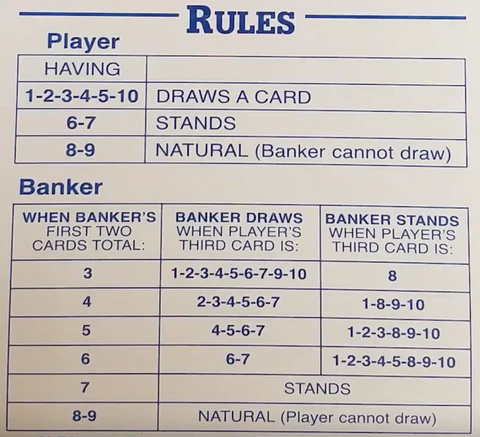
Complete Baccarat Third Card Rule Chart
For an easy-to-use reference at the tables, use this definitive summary of drawing parameters.
Player Third Card Rules
Banker Third Card Rules
When the Player draws a third card, the Banker draws (D) or stands (S) according to this exact matrix:
Easy Reference Guide for Beginners
The Golden Rule: If the Banker has a total of 7, they always stand. If the Banker has a total of 0, 1, or 2, they always draw. Anything in between (3, 4, 5, 6) requires you to cross-reference the chart against the Player’s third card.
Baccarat Third Card Rule Examples
Example 1: Player Draws, Banker Stands
- Initial Deal: Player has 3; Banker has 6.
- Action: Player draws a third card, which turns out to be a 2.
- Resolution: Looking at the chart, when the Banker has a 6 and the Player’s third card is a 2, the Banker must Stand. The round finishes.
Example 2: Both Player and Banker Draw
- Initial Deal: Player has 4; Banker has 5.
- Action: Player draws a third card, which turns out to be a 6.
- Resolution: With a Banker total of 5 and a Player third card of 6, the chart dictates the Banker must Draw. The Banker takes a card to determine the final score.
Example 3: Natural Win Ends the Round
- Initial Deal: Player has 5; Banker has 9.
- Action: The Banker has a Natural 9.
- Resolution: The game halts immediately. The Player is not permitted to draw a card despite having a total of 5. Banker wins.
Why the Banker Has More Complex Rules
The Logic Behind Banker Decisions
Baccarat is structured mathematically so that the Banker acts second. By observing what card the Player takes, the Banker can adapt its draw to maximize its chances of beating the Player’s newly adjusted total.
How Casinos Maintain Game Balance
The slight statistical edge given to the Banker by drawing second creates the game’s low house edge. To balance this advantage, casinos collect a standard 5% commission on winning Banker bets, evening the playing field for those who prefer wagering on the Player hand.
Common Mistakes Players Make With Third Card Rules
Misunderstanding Banker Draw Conditions
Many newcomers assume that if the Banker has a 5, it automatically draws because 5 is a low number. They forget that the Banker will stay flat on a 5 if the Player’s third card happens to be a low-value card like a 2 or 3.
Confusing Natural Wins and Third Card Situations
Players occasionally demand a third card for a low Player hand when the Banker has already revealed an 8 or 9. Remember, naturals freeze the board instantly.
Trying to Predict the Next Outcome
The third card rules are strictly mechanical. Misinterpreting them as customizable features can lead players to use flawed betting progression patterns based on imagined card trends.
Do Players Need to Memorize the Third Card Rule?
How Online Baccarat Applies the Rules Automatically
If you are playing online Baccarat, the gaming software applies these rules flawlessly and instantly. The system calculates the totals and dispenses third cards automatically, eliminating any chance of human error.
When Understanding the Rule Can Still Help
Even though the game is fully automated, knowing the rules helps you follow the action without confusion. It takes away the anxiety of feeling like you don’t know what’s happening to your money and lets you appreciate the natural suspense of the draw.
Tips for Learning Baccarat Third Card Rules
Use a Baccarat Rule Chart
Keep a digital or printed copy of the drawing matrix open next to your screen while playing online. Tracking the dealer’s moves along with the chart speeds up your learning process.
Focus on Player Rules First
Master the Player rules before moving to the Banker. Remembering that the Player stands on 6–7 and draws on 0–5 simplifies half of every round you play.
Practice With Free Baccarat Games
Utilize free play or demo versions of Baccarat online. Testing your understanding using play money removes financial risk while building pure muscle memory.
How the Third Card Rule Affects Baccarat Strategy
Does It Influence Betting Decisions?
Because you have zero control over the cards, the third card rule cannot be manipulated by an in-game strategy. Your only real strategy happens before the cards are dealt: deciding where to place your wager.
Banker vs Player Bet Considerations
Due to the defensive nature of the Banker’s rules, the Banker hand wins roughly 45.8% of the time, compared to 44.6% for the Player hand (with the remainder resulting in a Tie).
Understanding House Edge Implications
The intricate drawing mechanics result in highly favorable house edges:
- Banker Bet: ~1.06% house edge (even with the 5% commission).
- Player Bet: ~1.24% house edge.
Wagering on the Banker remains statistically the most optimal long-term decision in the game due to how the third card rules are mathematically weighted.
While the Baccarat Third Card Rule looks incredibly complex at first glance, it is nothing more than a mechanical blueprint that guarantees the game’s legendary fairness and low house edge. By taking a few moments to understand when and why a third card is dealt, you can step up to any baccarat table with complete peace of mind, ready to enjoy one of the cleanest, most strategic betting environments in casino history.